Impact Accounting and Hourly Matching: A Review of the Research into Outcomes

Download the metastudy paper PDF: Impact Accounting and Hourly Matching: A Review

The GHG Protocol is currently considering two different proposals for how emissions from electricity (Scope 2) are reported, which could have significant repercussions on the future of renewable energy purchasing. The two separate proposals are a) local hourly matching, which counts renewable energy only in the same location and hour it is consumed, and b) consequential impact accounting, which counts the total impact on emissions of an action. With corporations purchasing over 270 TWh of renewable energy in 2024, understanding the way that these reporting standards could shape those purchasing decisions is critical for the future of grid decarbonization.

Over the past year, a notable pattern has emerged in discussions convened through the ZEROgrid Impact Advisory Initiative between proponents of hourly matching and those favoring consequential approaches to clean energy procurement. Across these conversations, there was consensus on how to estimate the impact of renewable procurement: the change in total long-run real-world emissions compared with the scenario in which the procurement did not take place, recognizing that this hypothetical counterfactual scenario can often only be estimated but not directly measured. Disagreements were not on the definition of impact, but on how to best achieve impact and whether that emissions reduction impact should be the primary criterion to set an accounting standard around. 

The ZEROgrid Impact Advisory Initiative discussions led to two concrete outcomes. The first was the ZEROgrid white paper, jointly authored by both hourly matching and consequential advocates, clarifying the above definition of success. The second was recognition of a need for what we called the “impact metastudy”, to examine all available research on a single question: what is the effect on this impact of different accounting standards and the procurement methods they promote?

This idea found widespread support in several circles. At the June 2024 NREL/RMI workshop, a group of 30 companies and emissions experts endorsed the need for an impact metastudy. Work from numerous experts, in ZEROgrid and not, is used in the impact metastudy. In September 2025, Climate Breakthrough Foundation selected these kinds of impact metastudies for carbon accounting as one of the five most promising climate breakthroughs of 2025. 

Over the past year, WattTime has conducted work on the aforementioned impact metastudy. This metastudy comprises various studies on the impact of different possible carbon accounting standards. “Impact” is defined consistently with the first ZEROgrid report: reductions in total, real-world, long-run emissions, which are precisely mathematically defined, whether or not we are able to directly measure them.

To do this, we considered existing studies and worked to fill in gaps with new studies. The existing and new studies include: 

A further study, using data from Transition Zero, is also currently under development, so that chapter of this review is still forthcoming.

We used a variety of methods and models to perform these analyses to get a fuller picture of the outcomes of implementing these proposed standards, in order to understand what outcomes these different models agreed on. Today, we are publishing a review summarizing both our research and other relevant publications from other researchers [1,2,3]. Across the studies, we find four robust conclusions: 

These conclusions have strong implications for how a revision to the accounting standards will impact total global emissions. The currently proposed local hourly matching standard is likely to come at a high cost that could reduce total participation in voluntary procurement. Without a stronger additionality constraint, procurement will not lead to actual reductions in emissions. And a local deliverability requirement may reinforce the existing bias towards investing in relatively clean grids in the USA and Europe. By contrast, a consequential impact accounting standard could guide renewable energy purchasing into the dirtiest grids where projects have the most cost-effective impact on reducing emissions. This freedom in location could also lead to an expansion of investment in the Global South, where grids are dirtiest and renewable investment is the lowest today. A consequential reporting standard focused on emissions could provide the strongest signals to voluntary corporate renewable energy purchasers to reduce more global greenhouse gas emissions more quickly.

WattTime would like to especially thank Climate Breakthrough for the majority funding of this research. Thank you also to Apple, Meta Platforms, HPE Foundation, James and Kaye Slavet, and Reid Hoffman for providing funding or support. Thanks to Gurobi for providing access to their linear optimization software. The views expressed in the article do not necessarily represent the views of the sponsors.

Download the metastudy paper PDF: Impact Accounting and Hourly Matching: A Review

If you’re concerned about how the proposed revisions to Scope 2 could negatively impact your business or would just like to share your perspective with the GHG Protocol, they are accepting comments here through January 31, 2026. If you’d like more help navigating the two separate proposals and the two lengthy surveys, we’ve provided more guidance here.
A Global Approach to Renewables Purchasing Could Reduce 370% More Emissions than Local Hourly Matching

This post explains one set of findings from a larger research paper.

The full overview and paper are here: Impact Accounting and Hourly Matching: A Review

Global impact accounting will also redirect corporate renewable investment from the US and Europe to the Global South.

The Greenhouse Gas Protocol is currently considering two proposals to revise the emissions accounting standard for electricity use and renewable energy purchasing. One proposal would add hourly matching & deliverability requirements, meaning that renewable energy could only be counted if matched to the hour and location where electricity is consumed. The other separate proposal describes how to report the consequential impact (the change to total global emissions) of projects, regardless of their time and location (this is also sometimes referred to as impact accounting or emissions matching).

While there have been many studies that investigate the impact of the hourly matching requirement [1,2,3], there has not been an investigation into the global scale impact of the deliverability requirement (procuring renewable energy on the same grid as your load). Most studies have focused on voluntary renewable energy purchasing in the USA or Europe, which have the highest levels of renewable energy purchasing and comparatively low emissions per MWh. However, there are many countries in the world with much dirtier grids but low levels of renewable energy purchasing. Increased procurement of renewables in these countries could provide a much higher impact on avoided emissions per dollar spent, while simultaneously reducing health problems from local pollution and investing in historically under-invested economies.

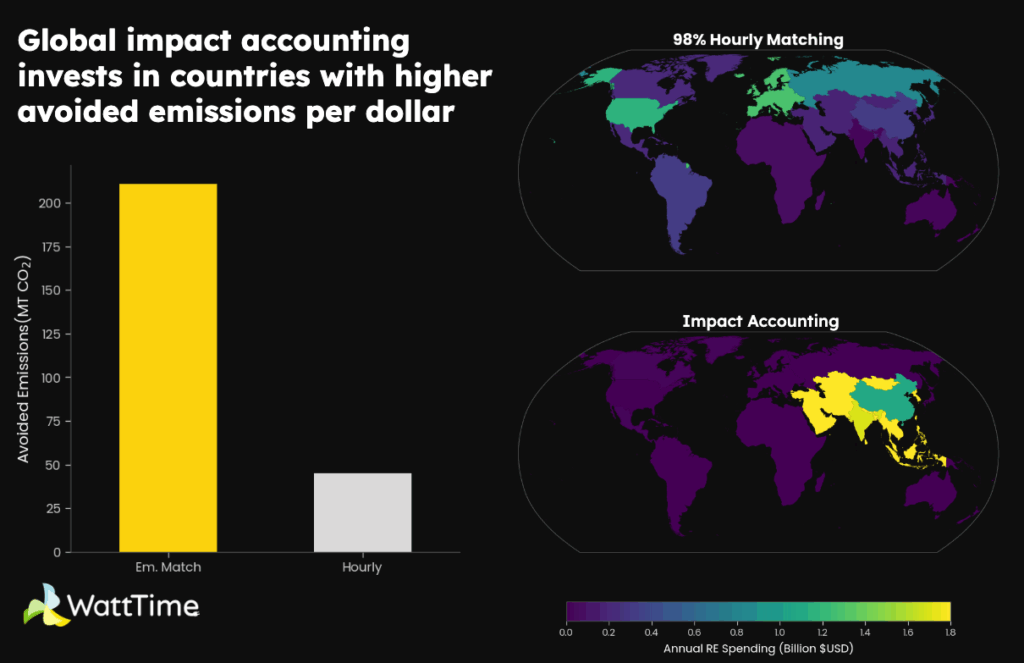
We studied the impacts on global voluntary renewable energy purchasing that could result from an hourly matching & deliverability standard and separately, from an impact accounting standard. We found that for a fixed cost, impact accounting avoids over 211 MT CO2 per year, 4.7 times more than hourly matching with deliverability.

Methodology and Data

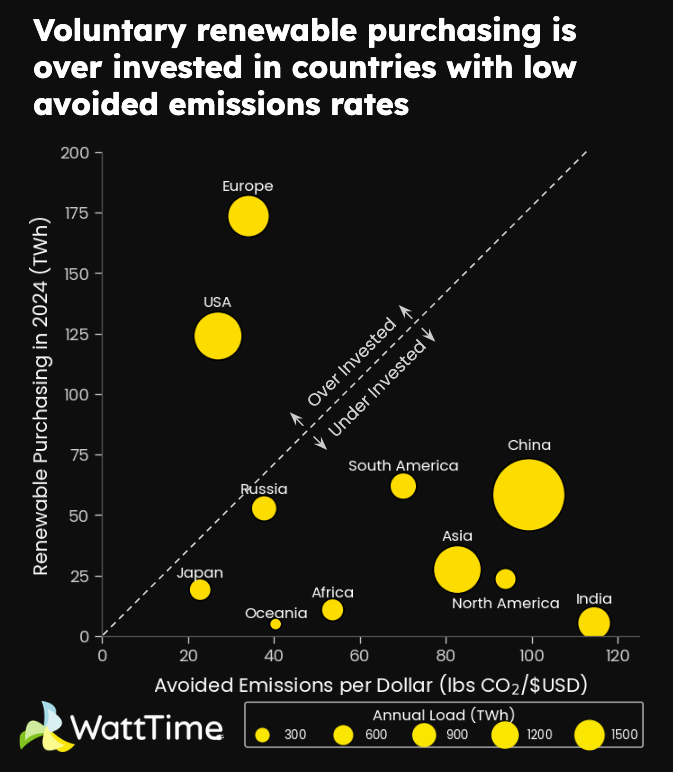
To model this, we simulated procurement portfolios globally under both an hourly matching & deliverable standard (“hourly matching” from here on) and an impact accounting standard. While the GHGP Scope 2 protocol is used globally, it is a voluntary standard that not all companies choose to follow. To estimate the relative levels of participation, we used the amount of purchased renewable energy from the 2024 Corporate Renewable Electricity Sourcing Trends report published by CDP. This report only covers companies that reported their location-based scope 2 emissions to CDP, which serves as a reasonable representation of the distribution of voluntary corporate purchases under the GHGP today. The distribution of historical voluntary purchasing is heavily skewed to the Global North, with the highest levels of renewable energy purchasing in Europe excluding Russia (175 TWh) and the USA (124 TWh). 

We modeled the purchasing decisions using a linear program (LP) method, which optimizes for the least-cost global voluntary energy purchasing of wind, solar, and battery resources subject to local hourly matching and emissions matching constraints. All procurement is assumed to be new build and fully additional. Global technology costs are taken from the IEA’s 2024 World Energy Outlook. We used the capital and operating costs for 2030 under the “Stated Policies” scenario. To annualize the capital costs, we amortized the costs over a 25-year lifetime and apply a 10% additional cost of capital. 

For hourly matching, we added the matching and local procurement constraint for an amount of load equal to the purchased renewable energy in each country (as reported by CDP). For impact accounting, we measure the induced emissions from load and the avoided emissions from renewable projects using the Combined Marginal Emissions Rate (CMER), which is the combined average of the Marginal Build Emissions Rate (MBER) and the Marginal Operating Emissions Rate (MOER). There is no location constraint for impact accounting, so projects can be selected from anywhere on the globe. To ensure that the solutions are reasonable, we add a constraint that the procured projects cannot exceed more than 20% of the total existing capacity from all generators in the country. This guarantees a solution where projects are spread among many countries, instead of concentrated in a single country with a volume that is impractical or unrealistic. If this constraint were removed, the model would concentrate procurement in a few countries with the highest emissions avoidance per cost, further amplifying the advantage of global impact accounting over hourly matching.

Global Impact Accounting Reduces More Emissions Per Dollar

In 2024, corporations procured a total of 562 TWh of clean energy globally. While we don't know the total cost of those clean energy purchases, if those 562 TWh of clean energy were instead procured in locations that maximized their avoided emissions, that portfolio of renewable energy procurement would cost $4.6B and avoid 211 MT of carbon emissions per year. Alternatively, that same $4.6B spent towards a 98% hourly match with local deliverability requirements, would only avoid 45 MT CO2 per year (4.7 times fewer avoided emissions). We chose to compare both strategies at a fixed amount of spending, instead of a fixed level of participation, because hourly matching portfolios are significantly more expensive than impact accounting portfolios. The total cost for a 98% hourly matched portfolio is 16.5 times more expensive than impact accounting. 

While some companies may be willing to pay a premium for reducing their scope 2 accounting, the expected trend is that fewer companies will voluntarily offset their scope 2 emissions as the cost of doing so increases because of basic demand elasticity (we explored this in a previous post analyzing participation vs. costs). Instead of assuming that participation will stay the same regardless of costs, as previous studies have done, we instead assumed there is a fixed budget available for voluntary corporate procurement. For the cost of all participants achieving 100% emissions matching, only 6% of participants could achieve an hourly matching score of 98%. While the exact amount and willingness to pay are not known, the difference in avoided emissions per dollar remains.

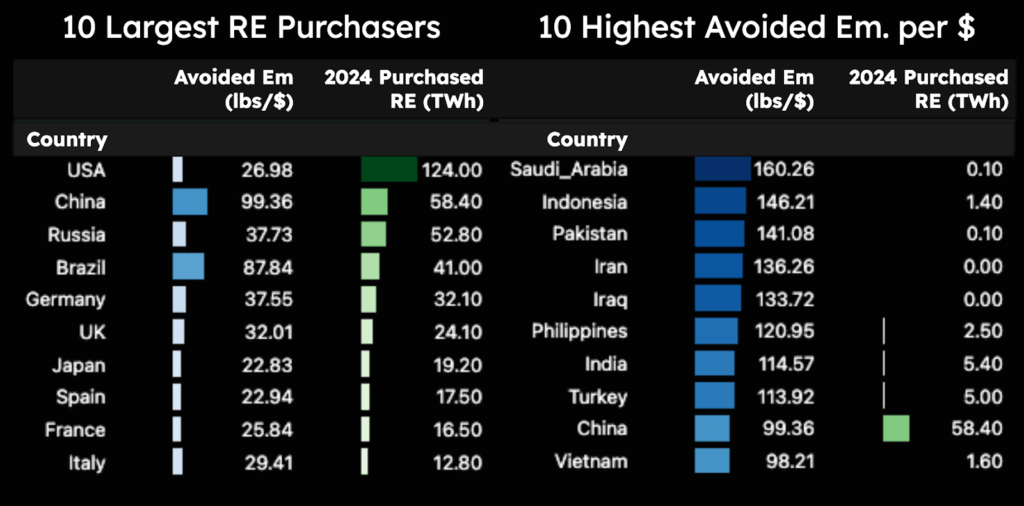
This difference in impact can be understood by looking at the average amount of avoided emissions per dollar spent for each strategy: 100 lbs CO2 per $USD for impact accounting vs. 21 lbs CO2 per $USD for hourly matching. These differences in avoided emissions per dollar spent reflect the fact that grids with historically high voluntary RE development are not grids with the highest marginal emissions rates.  Below is a list of the top 10 countries for RE purchasing and the top 10 countries by avoided emissions rate per dollar. The countries with the highest levels of RE purchasing are largely in the US or Europe, but also include China and Brazil. China is the only country with high levels of voluntary RE purchasing to also appear in the list of high-impact countries, which are primarily countries with developing economies in the Global South that have very low levels of voluntary RE purchasing today and high levels of fossil fuel generation.

Below, we also plot the average avoided emissions per dollar for the 5 largest countries by load, along with the average aggregated by region, excluding those 5 countries. Comparing the average avoided emissions per dollar and the level of existing purchases of renewables shows where today’s investing is highly concentrated in locations with low avoided emissions per dollar and locations with more cost-effective impact are underinvested. India and China have an avoided emissions impact of 114 and 99 lbs CO2/$USD respectively, compared with a rate of 34 and 27 lbs CO2/$USD for Europe and USA respectively. The average rates for the Americas and Asia, at 96 and 83 lbs CO2/$USD, are higher than the average rate in Africa of 54 lbs CO2/$USD. The aggregated rates are averages, and the countries inside a region can still have a large spread of avoided emissions rates.

Impact Accounting Directs Investments from the Global North to the Global South

We analyzed the locations where annual RE spending could go under an hourly matching and an impact accounting standard with the same amount of total investment. Under hourly matching, the local matching requirement means investment would be concentrated in the US and Europe, similar to how it is today. Under impact accounting, the optimal distribution of investment today is almost entirely in Asia. This means a dollar invested in Asia will avoid the most CO2. However, investors may prefer other locations when non-climate factors are considered, and they can still choose more impactful locations outside of Asia that aren’t in their local grids. 

A consequential impact accounting standard without a local matching requirement could incentivize companies based in the Global North to purchase renewable energy projects in countries in the Global South for much more cost-effective decarbonization than local hourly matching. This could potentially provide an economic benefit to these countries by creating demand for RE projects, as well as pressuring grids to allow renewable energy purchasing agreements, such as VPPAs, which would make even more RE development possible. In addition to the economic and carbon benefits, many of these countries have very poor air quality from fossil fuel generation, leading to significant health problems and loss of life. A recent study found that air pollution in India increased deaths by 1.5 million per year. Increased development of renewable energy would displace fossil fuel generation in many of these countries, reducing global carbon emissions and improving local health at the same time.

Why Scope 2 Should Embrace a Global Approach to Procurement

Research suggests that local hourly matching in the US and Europe could help reduce meaningful amounts of emissions only at high levels of matching and only if it includes an additionality requirement, which the current Scope 2 proposal does not. However, achieving a high level of additional hourly matching has also been shown to be up to four-times more expensive and might reduce voluntary participation. The local deliverability requirement also has the impact of continuing to concentrate renewable energy investment in the US and Europe, where significant progress on decarbonization has already been made, so adding it would even further erode the emissions reduction effectiveness of the accounting standard. 

A change to the Scope 2 protocol in favor of local hourly matching would undermine the overall effectiveness of voluntary corporate renewable energy purchasing. Local hourly matching is much less efficient than global impact accounting, which avoids more emissions per dollar. Global impact accounting could increase the impact of voluntary renewable energy purchasing in two ways: first, each dollar spent achieves greater emissions reductions, and second, more actors are likely to participate due to the lower costs. In addition, hourly matching would continue to concentrate renewable energy development in regions such as the U.S. and Europe, which already have a strong appetite for grid decarbonization, while limiting investments in countries where benefits are greater.Instead, allowing for impact accounting regardless of location could direct investment to countries that are at the beginning stages of decarbonization. Prioritizing these countries could reduce more emissions while addressing global inequity at the same time. Corporations such as Salesforce, Heineken and Amazon have already begun to purchase renewable energy across Africa, Southeast Asia and Latin America in order to prioritize high impact projects. A change to the Scope 2 protocol in favor of local hourly matching threatens the future of projects like these, since many would not be credited under such a standard. A global consequential impact accounting standard would instead incentivize companies to explore outside of their local boundaries and pursue more impactful projects worldwide.