WattTime and REsurety launch free Scope 2 carbon calculator that compares renewable energy claims under hourly matching and impact accounting frameworks

With the Greenhouse Gas Protocol's public comment period now underway, the tool provides corporate stakeholders with straightforward answers on how newly proposed Scope 2 accounting guidelines will directly affect their renewable energy claims.

BOSTON and OAKLAND, Calif., Dec. 1, 2025 /PRNewswire-PRWeb/ -- Environmental tech nonprofit WattTime and REsurety, leading provider of software, services, and marketplace solutions empowering the future of energy, today launched a free, easy-to-use Scope 2 accounting calculator. With the tool, companies can see how their reported and real-world Scope 2 greenhouse gas (GHG) emissions totals would compare under the hourly matching framework recently proposed by the Greenhouse Gas Protocol (GHGP) and an impact accounting approach like the one recommended by its Technical Working Group Consequential Subgroup. It also shows the cost implications for achieving higher emissions reductions under either framework.

The tool provides critical insights and much-needed clarity as corporate clean energy buyers and other key decision makers engage in the GHGP's public comment period, which closes on December 19, 2025.

The core GHGP Scope 2 public proposal includes a local-only hourly matching requirement for inventory accounting, along with a separate proposal for reporting non-supply chain actions using an impact (consequential) approach. These revised guidelines are expected to change not only how organizations report on their emissions, but also incentivize different procurement behaviors as companies attempt to reach ambitious clean energy and climate goals.

Today, however, these proposed guidelines remain largely theoretical to most organizations. Stakeholders need a clear and comprehensive understanding of how GHGP Scope 2 changes will directly affect them. WattTime and REsurety created this carbon calculator to fill that gap. In addition, they designed the tool to look beyond what is included in the GHGP's public consultation for voluntary impact accounting — which only looks at clean energy procurement — to calculate the impact of all activity, including power consumption, to better enable target setting and tracking.

"With the Greenhouse Gas Protocol's Scope 2 public comment period underway, and on the heels of COP30, this tool is coming at a critical moment," said Gavin McCormick, founder and executive director at WattTime. "Our hope is that it helps drive the conversations companies are already having about how they can make the biggest possible climate difference, anchored by facts and tailored to their priorities."

With an impact accounting framework based on comparing induced and avoided emissions, companies track the additional emissions reductions that result from their portfolio investments, making decisions based on the most impactful times and places to generate, procure, and consume electricity.

On the other hand, a local-only hourly matching framework requires companies to match their electricity loads on an hourly basis using renewable energy sources on the same grid as the company's original consumption.

"Corporate energy buyers are making big decisions today that will shape clean energy markets for decades to come," said Lee Taylor, CEO of REsurety. "This tool provides much-needed visibility into the trade-offs between two leading approaches, so they can make informed decisions during the public comment period."

To use the free Scope 2 accounting calculator, visit calculator.gridemissionsdata.io.

If you are interested in learning more about the tool and how it can help your organization engage throughout the GHGP's open comment period, email contact@gridemissionsdata.io.

About REsurety
REsurety is the leading provider of data, software, and services to the clean energy economy, and operates the only transactional marketplace for clean power. Trusted by the industry's leading buyers, sellers, and investors, REsurety's proprietary data models, powerful technology platforms, and deep domain expertise empower confident, impactful decision-making and efficient, effective portfolio management. For more information, visit www.resurety.com or follow REsurety on LinkedIn.

About WattTime
WattTime is an environmental tech nonprofit that empowers all people, companies, policymakers, and countries to slash emissions and choose cleaner energy. Founded by UC Berkeley researchers, we develop data-driven tools and policies that increase environmental and social good. During the energy transition from a fossil-fueled past to a zero-carbon future, WattTime 'bends the curve' of emissions reductions to realize deeper, faster benefits for people and planet. Learn more at www.WattTime.org.

Media Contact
Nikki Arnone and Logan Varsano, Inflection Point Agency for REsurety and WattTime, 1 (719) 357-8344, nikki@inflectionpointagency.comhttps://calculator.gridemissionsdata.io/

SOURCE REsurety and WattTime
A Global Approach to Renewables Purchasing Could Reduce 370% More Emissions than Local Hourly Matching

Global impact accounting will also redirect corporate renewable investment from the US and Europe to the Global South.

The Greenhouse Gas Protocol is currently considering two proposals to revise the emissions accounting standard for electricity use and renewable energy purchasing. One proposal would add hourly matching & deliverability requirements, meaning that renewable energy could only be counted if matched to the hour and location where electricity is consumed. The other separate proposal describes how to report the consequential impact (the change to total global emissions) of projects, regardless of their time and location (this is also sometimes referred to as impact accounting or emissions matching).

While there have been many studies that investigate the impact of the hourly matching requirement [1,2,3], there has not been an investigation into the global scale impact of the deliverability requirement (procuring renewable energy on the same grid as your load). Most studies have focused on voluntary renewable energy purchasing in the USA or Europe, which have the highest levels of renewable energy purchasing and comparatively low emissions per MWh. However, there are many countries in the world with much dirtier grids but low levels of renewable energy purchasing. Increased procurement of renewables in these countries could provide a much higher impact on avoided emissions per dollar spent, while simultaneously reducing health problems from local pollution and investing in historically under-invested economies.

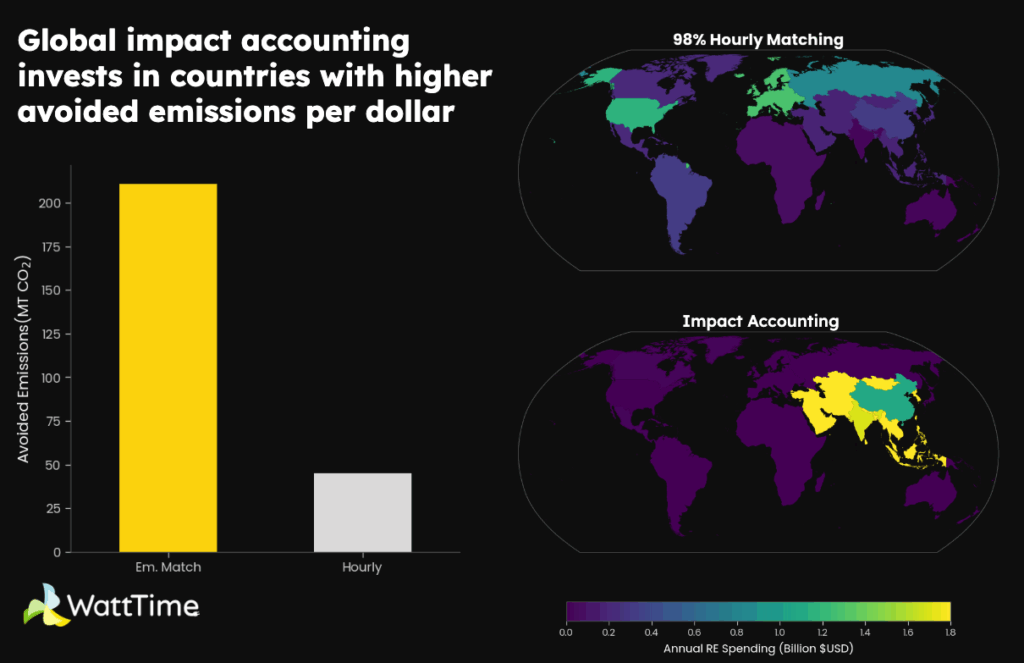
We studied the impacts on global voluntary renewable energy purchasing that could result from an hourly matching & deliverability standard and separately, from an impact accounting standard. We found that for a fixed cost, impact accounting avoids over 211 MT CO2 per year, 4.7 times more than hourly matching with deliverability.

Methodology and Data

To model this, we simulated procurement portfolios globally under both an hourly matching & deliverable standard (“hourly matching” from here on) and an impact accounting standard. While the GHGP Scope 2 protocol is used globally, it is a voluntary standard that not all companies choose to follow. To estimate the relative levels of participation, we used the amount of purchased renewable energy from the 2024 Corporate Renewable Electricity Sourcing Trends report published by CDP. This report only covers companies that reported their location-based scope 2 emissions to CDP, which serves as a reasonable representation of the distribution of voluntary corporate purchases under the GHGP today. The distribution of historical voluntary purchasing is heavily skewed to the Global North, with the highest levels of renewable energy purchasing in Europe excluding Russia (175 TWh) and the USA (124 TWh). 

We modeled the purchasing decisions using a linear program (LP) method, which optimizes for the least-cost global voluntary energy purchasing of wind, solar, and battery resources subject to local hourly matching and emissions matching constraints. All procurement is assumed to be new build and fully additional. Global technology costs are taken from the IEA’s 2024 World Energy Outlook. We used the capital and operating costs for 2030 under the “Stated Policies” scenario. To annualize the capital costs, we amortized the costs over a 25-year lifetime and apply a 10% additional cost of capital. 

For hourly matching, we added the matching and local procurement constraint for an amount of load equal to the purchased renewable energy in each country (as reported by CDP). For impact accounting, we measure the induced emissions from load and the avoided emissions from renewable projects using the Combined Marginal Emissions Rate (CMER), which is the combined average of the Marginal Build Emissions Rate (MBER) and the Marginal Operating Emissions Rate (MOER). There is no location constraint for impact accounting, so projects can be selected from anywhere on the globe. To ensure that the solutions are reasonable, we add a constraint that the procured projects cannot exceed more than 20% of the total existing capacity from all generators in the country. This guarantees a solution where projects are spread among many countries, instead of concentrated in a single country with a volume that is impractical or unrealistic. If this constraint were removed, the model would concentrate procurement in a few countries with the highest emissions avoidance per cost, further amplifying the advantage of global impact accounting over hourly matching.

Global Impact Accounting Reduces More Emissions Per Dollar

In 2024, corporations procured a total of 562 TWh of clean energy globally. While we don't know the total cost of those clean energy purchases, if those 562 TWh of clean energy were instead procured in locations that maximized their avoided emissions, that portfolio of renewable energy procurement would cost $4.6B and avoid 211 MT of carbon emissions per year. Alternatively, that same $4.6B spent towards a 98% hourly match with local deliverability requirements, would only avoid 45 MT CO2 per year (4.7 times fewer avoided emissions). We chose to compare both strategies at a fixed amount of spending, instead of a fixed level of participation, because hourly matching portfolios are significantly more expensive than impact accounting portfolios. The total cost for a 98% hourly matched portfolio is 16.5 times more expensive than impact accounting. 

While some companies may be willing to pay a premium for reducing their scope 2 accounting, the expected trend is that fewer companies will voluntarily offset their scope 2 emissions as the cost of doing so increases because of basic demand elasticity (we explored this in a previous post analyzing participation vs. costs). Instead of assuming that participation will stay the same regardless of costs, as previous studies have done, we instead assumed there is a fixed budget available for voluntary corporate procurement. For the cost of all participants achieving 100% emissions matching, only 6% of participants could achieve an hourly matching score of 98%. While the exact amount and willingness to pay are not known, the difference in avoided emissions per dollar remains.

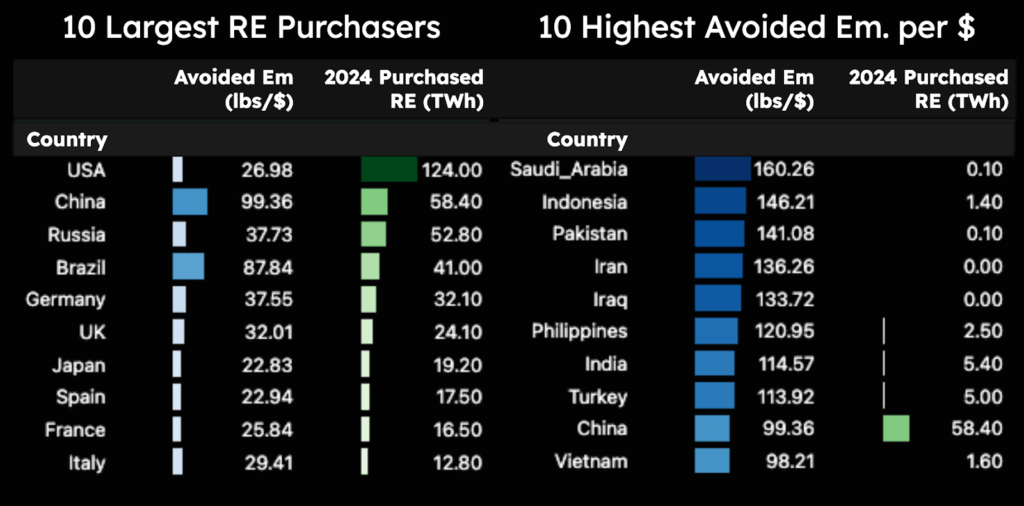
This difference in impact can be understood by looking at the average amount of avoided emissions per dollar spent for each strategy: 100 lbs CO2 per $USD for impact accounting vs. 21 lbs CO2 per $USD for hourly matching. These differences in avoided emissions per dollar spent reflect the fact that grids with historically high voluntary RE development are not grids with the highest marginal emissions rates.  Below is a list of the top 10 countries for RE purchasing and the top 10 countries by avoided emissions rate per dollar. The countries with the highest levels of RE purchasing are largely in the US or Europe, but also include China and Brazil. China is the only country with high levels of voluntary RE purchasing to also appear in the list of high-impact countries, which are primarily countries with developing economies in the Global South that have very low levels of voluntary RE purchasing today and high levels of fossil fuel generation.

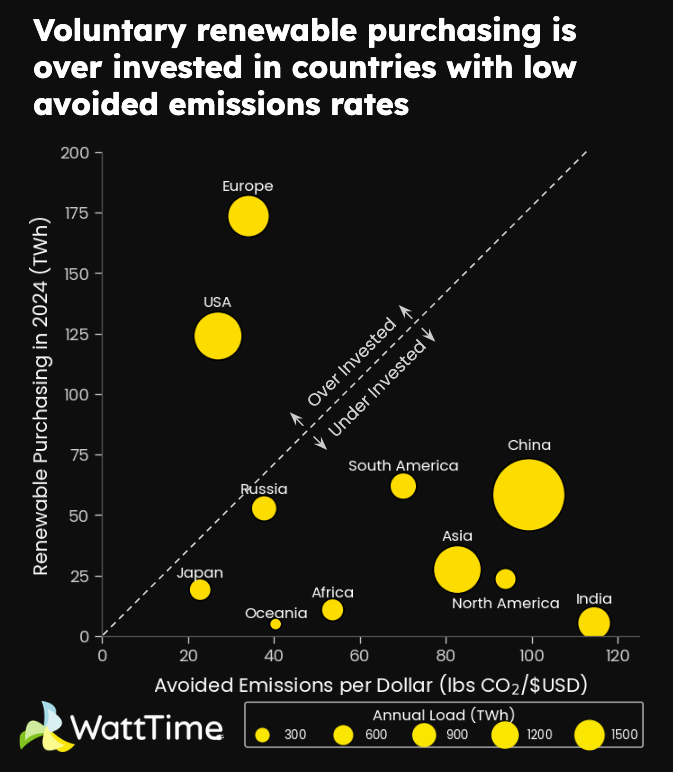
Below, we also plot the average avoided emissions per dollar for the 5 largest countries by load, along with the average aggregated by region, excluding those 5 countries. Comparing the average avoided emissions per dollar and the level of existing purchases of renewables shows where today’s investing is highly concentrated in locations with low avoided emissions per dollar and locations with more cost-effective impact are underinvested. India and China have an avoided emissions impact of 114 and 99 lbs CO2/$USD respectively, compared with a rate of 34 and 27 lbs CO2/$USD for Europe and USA respectively. The average rates for the Americas and Asia, at 96 and 83 lbs CO2/$USD, are higher than the average rate in Africa of 54 lbs CO2/$USD. The aggregated rates are averages, and the countries inside a region can still have a large spread of avoided emissions rates.

Impact Accounting Directs Investments from the Global North to the Global South

We analyzed the locations where annual RE spending could go under an hourly matching and an impact accounting standard with the same amount of total investment. Under hourly matching, the local matching requirement means investment would be concentrated in the US and Europe, similar to how it is today. Under impact accounting, the optimal distribution of investment today is almost entirely in Asia. This means a dollar invested in Asia will avoid the most CO2. However, investors may prefer other locations when non-climate factors are considered, and they can still choose more impactful locations outside of Asia that aren’t in their local grids. 

A consequential impact accounting standard without a local matching requirement could incentivize companies based in the Global North to purchase renewable energy projects in countries in the Global South for much more cost-effective decarbonization than local hourly matching. This could potentially provide an economic benefit to these countries by creating demand for RE projects, as well as pressuring grids to allow renewable energy purchasing agreements, such as VPPAs, which would make even more RE development possible. In addition to the economic and carbon benefits, many of these countries have very poor air quality from fossil fuel generation, leading to significant health problems and loss of life. A recent study found that air pollution in India increased deaths by 1.5 million per year. Increased development of renewable energy would displace fossil fuel generation in many of these countries, reducing global carbon emissions and improving local health at the same time.

Why Scope 2 Should Embrace a Global Approach to Procurement

Research suggests that local hourly matching in the US and Europe could help reduce meaningful amounts of emissions only at high levels of matching and only if it includes an additionality requirement, which the current Scope 2 proposal does not. However, achieving a high level of additional hourly matching has also been shown to be up to four-times more expensive and might reduce voluntary participation. The local deliverability requirement also has the impact of continuing to concentrate renewable energy investment in the US and Europe, where significant progress on decarbonization has already been made, so adding it would even further erode the emissions reduction effectiveness of the accounting standard. 

A change to the Scope 2 protocol in favor of local hourly matching would undermine the overall effectiveness of voluntary corporate renewable energy purchasing. Local hourly matching is much less efficient than global impact accounting, which avoids more emissions per dollar. Global impact accounting could increase the impact of voluntary renewable energy purchasing in two ways: first, each dollar spent achieves greater emissions reductions, and second, more actors are likely to participate due to the lower costs. In addition, hourly matching would continue to concentrate renewable energy development in regions such as the U.S. and Europe, which already have a strong appetite for grid decarbonization, while limiting investments in countries where benefits are greater.Instead, allowing for impact accounting regardless of location could direct investment to countries that are at the beginning stages of decarbonization. Prioritizing these countries could reduce more emissions while addressing global inequity at the same time. Corporations such as Salesforce, Heineken and Amazon have already begun to purchase renewable energy across Africa, Southeast Asia and Latin America in order to prioritize high impact projects. A change to the Scope 2 protocol in favor of local hourly matching threatens the future of projects like these, since many would not be credited under such a standard. A global consequential impact accounting standard would instead incentivize companies to explore outside of their local boundaries and pursue more impactful projects worldwide.

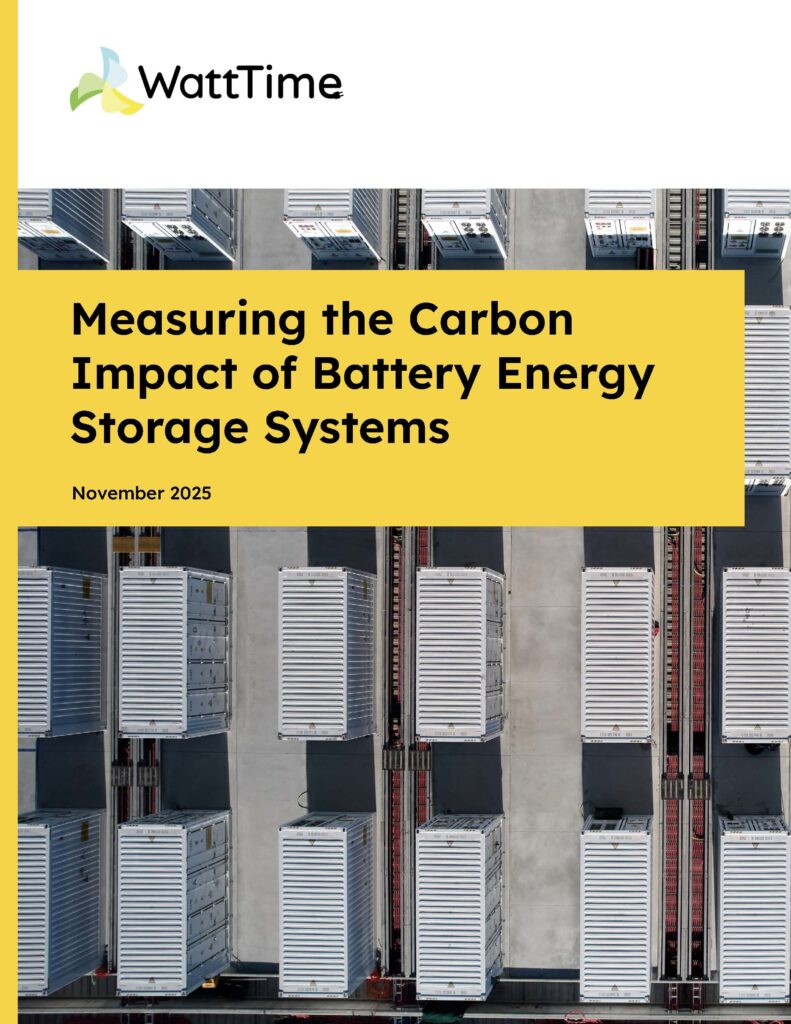
Analysis: Measuring the Carbon Impact of Battery Energy Storage Systems

Executive Summary

As the deployment of commercial-scale battery energy storage systems (BESS) accelerates, companies are seeking a common standard for quantifying the system-wide emissions impact that they cause.Companies that operate BESS are also integrating real-time emissions forecasts as signals to optimize the timing of charge/discharge cycles. To the extent that the goal of this strategy is to measure and reduce CO2 emissions into the atmosphere, both the measurement and control signals must use consequential emissions factors to measure and achieve the desired outcome.

This study assesses an Amazon-enabled BESS in California to demonstrate a practical way of estimating the atmospheric CO2 emissions caused by a BESS (including the system-wide short- and long-run impacts) using freely and globally available data. This study also showed that a battery can be operated to achieve multiple objectives (revenue and CO2 avoidance) by very simply combining both objectives into the control signal. It also shows the high cost that can come from using a CO2 signal that doesn’t measure consequential atmospheric emissions impact (e.g., hourly average emissions rates as used in GHG Protocol Corporate Standard Scope 2 reporting).

Estimating the Impact of BESS is Practical

WattTime analyzed an Amazon-enabled BESS in California as a case study to demonstrate a practical method for estimating the consequential emissions impact of a BESS. We used an approach consistent with well-established guidelines and standards for consequential analysis and emissions factors that are freely and globally available. This approach is accessible to any party operating a BESS today.

BESS Can Achieve Multiple Objectives

We found that when the BESS had been operated to maximize revenue, it also avoided substantial CO2 emissions. This outcome would not occur everywhere; it is more likely in places with surplus renewables whose curtailment aligns with negative wholesale prices.

We also analyzed several theoretical scenarios for dispatching the BESS for multiple objectives. We found that there was significant additional potential to avoid CO2—up to 45% more—by combining emissions and price signals when optimizing the dispatch timing of the BESS (this technique is applicable everywhere, with varying degrees of emissions upside).

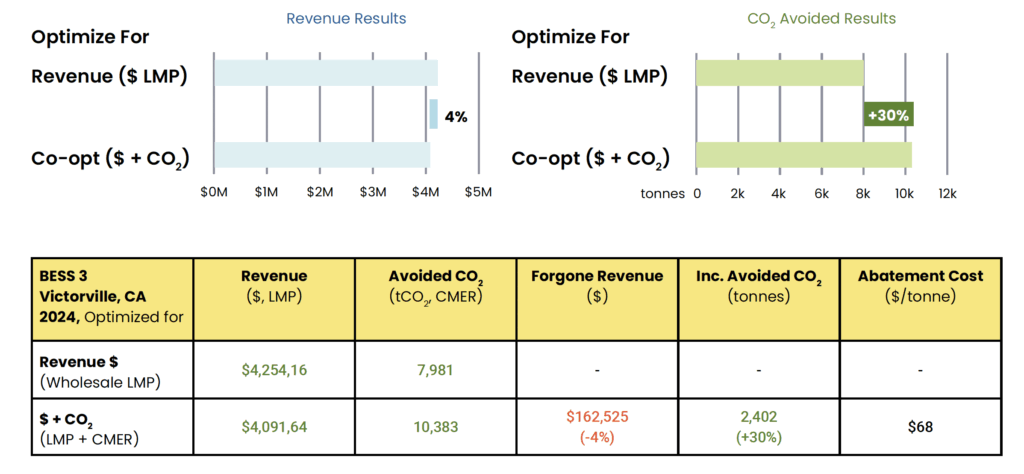
Different companies may have different budgets and different ideal outcomes. We demonstrated that the objective outcomes can be balanced by customizing the weight of each. There’s a wide range of CO2 abatement costs, from $45 to $170 per tonne, that achieve better than 85% of the best-case outcomes for both objectives. For example, the BESS could avoid 30% more CO2 emissions, while only giving up 4% of maximum revenue, at an abatement cost of $68 per tonne.


The Risks of Optimizing to Reduce Hourly Scope 2 Footprint

Many companies produce annual carbon accounting inventory reports using the GHG Protocol Corporate Standard under Scope 2 for electricity, using data of annual granularity. For BESS to be reflected in this inventory, hourly accounting is necessary. However, this shift to hourly Scope 2 accounting using an attributional framework could incentivize BESS optimization using an attributional signal (i.e., average emissions rates). There are significant climate, health, and financial risks to companies using this attributional framework to guide operational strategy or decision-making. To quantify those risks, we analyzed the outcomes for a hypothetical case where the BESS was optimized to minimize a Scope 2 carbon footprint, measured hourly.

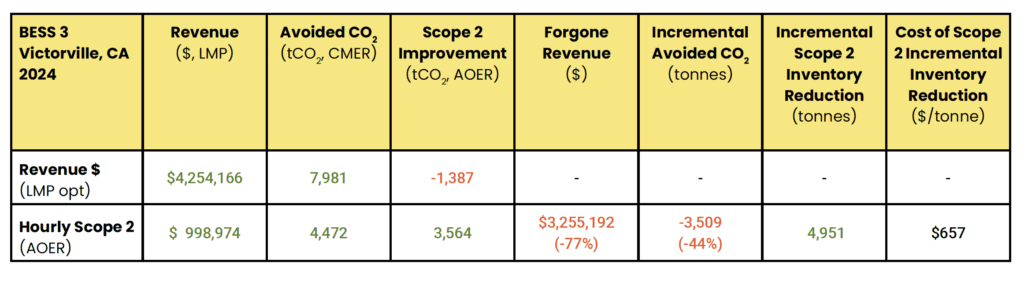
Optimizing the BESS to reduce a company’s Scope 2 hourly carbon footprint would cost $657 per tonne of CO2 inventory reduction. While it would reduce carbon footprint on paper, it would cause an increase in CO2 in Earth’s atmosphere by an estimated 3,509 tonnes. The real-world impact of such an approach extends beyond GHG emissions. On coal-powered grids this increase in CO2 emissions would be coupled with an increase in co-pollutants(e.g., particulate) emissions, which are damaging to human health and cause premature death. This shows the high cost that would come with operating a BESS to reduce a company’s attributional carbon footprint on paper instead of aiming to reduce atmospheric CO2.

Download the white paper PDF: Measuring the Carbon Impact of Battery Energy Storage Systems

Hourly matching without additionality has little to no impact on emissions reductions

Hourly matching only accelerates renewable energy progress if additionality is part of the standard

The current proposal for an hourly matching standard in the Greenhouse Gas Protocol Scope 2 reporting standard does not include requirements that matched energy be additional. This means that voluntary corporate clean energy buyers could claim energy attribute certificates (EACs such as RECs or GOs) from already-built clean generation resources towards reducing their carbon footprint. This will likely lead to lower amounts of clean energy on the grid and higher emissions compared to a stricter standard.

Additionality is defined as an intervention that causes an action that would not have occurred otherwise. For example, a corporation signing a voluntary PPA for solar or wind energy (the intervention) provides the financial certainty for a new clean energy project to get financed, built, and interconnected to the power grid (the caused action). This has long been understood as a critical principle of clean energy procurement necessary to cause the desired reduction in carbon emissions (Bjørn et al. 2025).

Previous studies have reported that hourly matching can reduce emissions, but almost all of them assume at least some level of additionality for the procured renewable resources. Only one work (Ricks et al. 2023) considered hourly matching without an additionality requirement, in the context of US hydrogen production, and found that without additionality “a 100% hourly matching requirement loses all of its consequential impact." 

In order to understand the impacts of an hourly matching standard as it is currently proposed, we used the PyPSA-Eur capacity expansion and dispatch model to analyze the impacts of an hourly matching standard with and without additionality requirements in the European grid in 2030. We find that a non-additional hourly matching standard has little to no impact on total system emissions.

How our analysis modeled additionality and hourly matching

Because true additionality depends on a counterfactual, it can be difficult to determine outside of models. Instead, a “new build” requirement is often used as a benchmark for additionality in renewable energy. Many groups have also proposed that for a project to be additional, there needs to be a long-term contract, which has been shown to significantly reduce risk for renewable project financing.

Meanwhile, purchasing energy from an existing project that has already been built and is already in operation is — by definition — not additional, since the action (building the generation resource) happened before the intervention (purchasing the RECs).

We modeled additionality using scenarios where only new build resources are allowed to count towards the hourly matching goals, and modeled non-additionality using scenarios where clean generation of any age can count towards the hourly matching goals (consistent with current GHGP Scope 2 proposals).

From an economic perspective, consumer demand for hourly matched RECs could increase the supply of clean energy, if the demand is high enough. In practice, we see that supply of unbundled RECs often surpasses demand, leading to low REC prices that have little impact on causing additional new renewable resources to be built.

Hourly matching proponents argue that its time-matching requirement will make REC supply scarce during certain hours, driving up the cost of RECs in those hours and leading to more investment in clean resources that generate during those times. However, this effect only occurs if the demand for RECs in those hours substantially exceeds the supply.

If unbundled RECs from existing generators are allowed (as in the current Scope 2 proposal), our modeling indicated that in the case of the European grid in 2030, a demand for clean energy attributes from 25% of all commercial and industrial (C&I) load is insufficient to cause investments that lead to significant emissions reductions.

Modeled scenarios

We also investigated the impacts of different methods of accounting for clean attributes of energy consumed from the grid.

For all three of these scenarios, we modeled a requirement that procured resources are all new build (additional). We then modeled the scenario (“No New Build Req”) where there is no new build requirement by allowing consumers to count any amount of clean energy credits up to the total amount available on the grid.

An illustration of different ways of counting grid CFE for an hour with the same amount of purchased CFE. Assuming an hour where 50% of generation on the grid is carbon free and participating consumers have 75% of their load matched by a carbon-free PPA resource. If Grid CFE is counted proportional to “imports”, the 50% of CFE on the grid is applied to the 25% of load that is not met by the purchased CFE, increasing the hourly matching score by 12.5% to a total of 87.5%. If Grid CFE is counted using the SSS, the 50% of CFE on the grid is applied to the entire load, increasing the hourly matching score from 75% to 125%. If there is no new build requirement, consumers could meet up to 100% of their matching requirement with clean energy credits from grid resources if their demand is less than the total amount of clean energy credits on the grid in that hour.

No additionality means no impact

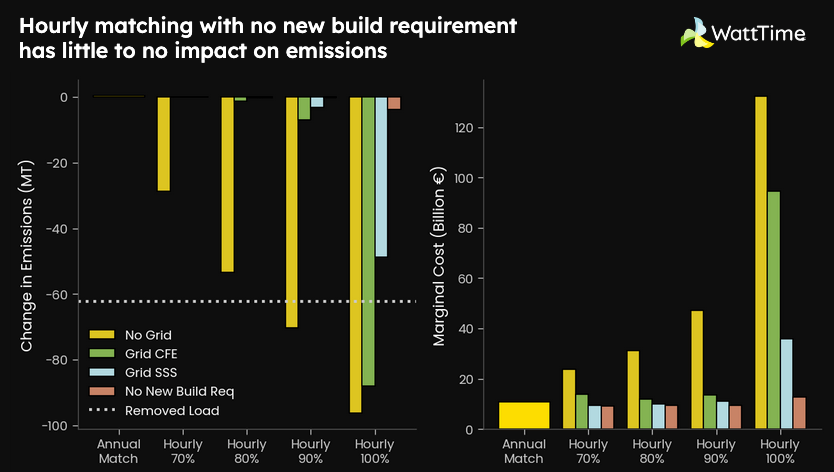
Without a new build requirement, we find that hourly matching has no emissions benefit for matching levels up to 90%. Even at a 100% hourly match, it has only a small benefit (4 MT) compared to the emissions caused by the load (62 MT). This is likely because there is a large amount of carbon-free energy already on the grid in Europe in 2030 without the addition of corporate procurement. If the corporate procurement is not limited to new build, buyers can take credit for the many carbon-free generation sources that already exist on the grid, including wind, solar, nuclear, and hydro. These purchases are non-additional, so they do not lead to changes in total system emissions. To achieve 100% matching, some additional resources are required, but they amount to a comparatively small amount of wind and battery storage resources. The battery storage resources are mostly dispatched to charge during times when there is excess CFE credits available and discharge during hours when there are fewer.

If a new build requirement was added, hourly matching is only impactful at high levels of hourly matching or if grid resources are not counted towards the hourly match. But these high-impact scenarios are also much higher in cost. Hourly matching that counts grid CFE either proportional to “imports” or SSS can have a significant impact on emissions if 100% hourly matching is achieved. However, below 100% matching, the emissions-reduction impact is small to non-existent. Again, this is likely caused by the high levels of CFE already on the European grid, which means corporate buyers can take credit for those existing resources and have a fairly high hourly matching score. The scenarios where no CFE from the grid is counted have a higher impact at all levels of matching, but also come at a much higher cost, exceeding €120 Billion in the 100% matching case. These high costs could be a deterrent, reducing the number of corporations willing to pursue voluntary renewable purchasing.

These results show that the specifics of how an hourly matching standard is written can lead to massive differences in reported emissions without any change in real-world grid decarbonization. The current proposed standard, which lacks a new build additionality requirement, will increase the difficulty of implementation by requiring more detailed accounting, but is likely to lead to little to no actual reduction in emissions. Adding a new build requirement to the standard could increase the impact, but it is highly dependent on how grid resources are counted towards the standard. The scenarios where impact is high come with a high cost however, which corporate buyers may not be willing to pay. This study also highlights the importance of considering all of the details when comparing a proposed standard to existing studies, as those studies may not apply to the proposed standard (as is the case here). This is the first time that hourly matching without a new build requirement (as proposed) has been studied, so previous research on hourly matching should not be used to project the impacts of the current proposed standard.

These results are part of a larger study we plan to release in the near future. If you are interested in learning more about it, or would like to access the code or data that was used to model these scenarios, please contact nat@watttime.org.

hero image: iStock / shaunl

More than one billion smart devices now using marginal emissions data to slash power grid pollution with WattTime's 'AER'

As Automated Emissions Reduction (AER) technology continues to scale in smart devices across the globe — including Toyota and BMW EVs, Amazon and Google Nest smart thermostats, Apple iPhones, and more — it has the potential to reduce three billion tonnes of carbon emissions per year by 2030.  

Oakland, Calif. — 14 October 2025 /PRNewswire-PRWeb/ Environmental tech nonprofit WattTime today announced that more than one billion smart devices globally are now using its marginal emissions data to reduce greenhouse gas emissions from electricity use, in what WattTime calls Automated Emissions Reduction (AER) technology. For context, that’s about twice the combined global subscriber base of Netflix and Amazon Prime, and roughly half the number of Instagram users worldwide.

AER enables electric vehicles (EVs), thermostats, smartphones, and other internet-connected devices to automatically use electricity at times that will cause less pollution, which can vary significantly by location and time of day. This means avoiding the use of electricity when it requires a dirty, fossil fuel power plant to meet that need and instead using more power at times when excess renewable energy is available. 

“What matters to me is stopping climate change, not actually whether people do it with WattTime’s data or someone else’s,” said Gavin McCormick, WattTime Founder and Executive Director. “What’s important here is that so many people are now shifting electricity from times that genuinely make fossil fuel plants run, to times that don’t. I would be so thrilled if, next, someone else announces they’ve enabled even more AER users than we have.”

AER continues to be recognized for its positive climate impact and easy implementation, most recently earning a spot on TIME’s 2025 Best Inventions list last week. McCormick has similarly been awarded for his impact-focused efforts, including his work with AER. Last month, McCormick was featured on Forbes’ 2025 Sustainability Leaders List and named a winner of global philanthropy nonprofit Climate Breakthrough’s 2025 Climate Breakthrough Award.

As for success in the field, many of the world’s largest corporations have already adopted AER, in some cases adding it to more than 100 million new devices in one day. 

Some companies and products that have deployed WattTime’s AER thus far include:

For a detailed list of AER implementations, click here.

EV charging has been an especially impactful use case, due to its flexibility and high energy use. EV companies with AER-enabled charging deployed or in development make up 20% of the global EV market as of 2024. The ubiquity of AER for EVs continues to gain momentum, as WattTime’s partner Rivian is currently integrating WattTime’s marginal emissions data.

Other examples of the many flexible, internet-connected devices and services that can leverage AER include heat pumps, home appliances, battery-powered tools, building energy management software, data centers, virtual computing, and AI training jobs.

“AER is a force multiplier for building decarbonization. Together, our autonomous AI tech and AER demonstrated their positive impact on grid energy use. By shifting building electricity consumption to smarter times, we achieved two key outcomes: reduced emissions and greater use of renewable energy that would otherwise be wasted,” said Jean-Simon Venne, President and Founder at BrainBox AI.

AER’s growing reach has been bolstered by WattTime’s October 2024 global expansion of the first-ever real-time electricity marginal emissions dataset, which made AER available for nearly every country worldwide. After talking with its existing partners about their expansion plans, WattTime believes AER availability will likely double to reach two billion devices in about nine months. 

“Flexible loads like AI and electric vehicles are growing so fast. Based on the US Department of Energy’s projections of growth rates, if everyone adopted this simple, nearly free technology, AER could prevent three billion tonnes of carbon dioxide annually by 2030. That’s about 8% of all greenhouse gas emissions, or larger than any country’s emissions worldwide except China, the US, India, or Russia,” said McCormick.

For EVs in particular, AER can reduce grid emissions from charging by up to 18% annually, and more than 90% on individual days. In other technologies, use of AER has achieved reductions of 25–90%, depending on the device, time of day, and grid region. 

WattTime and others continue to develop new innovations in AER. Most recently, grid operators such as PJM, MISO, and NYISO have joined California in releasing official marginal emissions datasets that make it possible to measure the impact of AER using data straight from the local grid operator or government.

AER can also be programmed to reduce not only carbon dioxide emissions, but also health-damaging air pollutants. For example, companies like Toyota have integrated AER in their app software to create a charging schedule that is likely to reduce both the health and climate impacts of charging with grid electricity. AER can also optimize for the reduction of renewable energy waste, enabling power grids to absorb up to 20% more clean electricity from solar and wind farms.

The other key technology WattTime deploys using marginal emissions, Emissionality, also continues to scale rapidly, having grown from one billion watts to fifteen billion watts in the last twelve months. 

Learn more about AER here. And connect with the WattTime team by sending a message here.   

###

About WattTime
WattTime is an environmental tech nonprofit that empowers all people, companies, policymakers, and countries to slash emissions and choose cleaner energy. Founded by UC Berkeley researchers, we develop data-driven tools and policies that increase environmental and social good. During the energy transition from a fossil-fueled past to a zero-carbon future, WattTime 'bends the curve' of emissions reductions to realize deeper, faster benefits for people and planet. Learn more at www.WattTime.org. 

Media contact
Nikki Arnone, Inflection Point Agency for WattTime
nikki@inflectionpointagency.com

WattTime’s Gavin McCormick Wins 2025 Climate Breakthrough Award to Offer Free Impact Analysis for Carbon Accounting Standards

McCormick’s new initiative is one of five selected for its potential to achieve dramatic gigaton-scale “breakthrough” climate impact. 

Oakland, Calif. — 15 September 2025 — Environmental tech nonprofit WattTime today announced that its cofounder and executive director, Gavin McCormick, has been named a winner of global philanthropy nonprofit Climate Breakthrough’s 2025 Climate Breakthrough Award. Climate Breakthrough recognized McCormick for a new initiative that will offer free impact analysis to any interested government and private sector organizations developing carbon accounting systems.

Climate Breakthrough provides $4 million in multiyear, flexible funding — the largest climate award for individuals — for experienced environmental and social change leaders to develop, launch, and scale new high-impact initiatives that Climate Breakthrough concludes could significantly reduce global annual greenhouse gas emissions. All Climate Breakthrough awards must have the potential to materially change the lives of tens of millions and reduce at least 500 million tons of emissions within ten years of launch. 

Through this new initiative, McCormick and his team will help facilitate groups of independent scientists to provide free impact analysis of potential carbon accounting systems and policies before they are completed. The work will combine McCormick’s prior experience individually conducting such analyses at WattTime and the US Department of Energy, with his current experience in the Climate TRACE coalition facilitating groups of independent experts from many organizations in reaching consensus. 

Climate Breakthrough’s analysis concluded this initiative could exceed 2.9 gigatons of annual pollution reduction by 2036. Such large potential is driven by three trends: 

Many policymakers and standards bodies have expressed particular interest in impact analysis jointly conducted by groups of experts from multiple independent institutions. To that end, the new initiative will focus on metastudies, which review and analyze a set of existing studies to synthesize their findings, that examine varying results and explore where there is — and where there is not — consensus on which options would drive the most impact. 

Climate Breakthrough selected McCormick partly due to his technical expertise, but also his proven ability to gather diverse stakeholders and his exceptional talent for helping different technical communities understand one another.

For a full list of 2025 Awardees, read the Climate Breakthrough announcement here. And connect with the WattTime team by sending a message here.   

###

About WattTime
WattTime is an environmental tech nonprofit that empowers all people, companies, policymakers, and countries to slash emissions and choose cleaner energy. Founded by UC Berkeley researchers, we develop data-driven tools and policies that increase environmental and social good. During the energy transition from a fossil-fueled past to a zero-carbon future, WattTime 'bends the curve' of emissions reductions to realize deeper, faster benefits for people and planet. Learn more at www.watttime.org. 

Media contact
Nikki Arnone, Inflection Point Agency for WattTime
nikki@inflectionpointagency.com  
Logan Varsano, Inflection Point Agency for WattTime
logan@inflectionpointagency.com

Analysis: mandatory hourly matching’s high costs would likely kill so much clean energy procurement, it would increase total long-run emissions.

As the GHGP undertakes revisions to its Scope 2 guidance to evolve beyond the current status quo of annual matching, hourly matching with tighter market boundaries (aka 24/7 CFE) is a prominent contender.

Studies suggest that if a company's hourly matching percentage is high enough and the clean energy is fully deliverable — both big assumptions — hourly matching could avoid more emissions than current annual matching. But... and it's a big but... hourly matching is SIGNIFICANTLY more expensive.

That added cost could have a large negative influence on the voluntary corporate clean energy procurement market. The core economic principle that underpins this concern is “demand elasticity”: that when something becomes more expensive, companies will do less of it. And in this case, the “it” is voluntary clean energy procurement.

If the GHGP mandates hourly matching, it might increase the beneficial impact of each company that continues to buy renewables following GHGP guidance, but it would also reduce the number of companies who do so. So, we investigated the net result of those two opposing forces. In this analysis, we take a closer look at the numbers, using both third-party, peer-reviewed studies (such as He, et al. and Riepin and Brown) and WattTime data.

Our analysis finds that, based on best available data, it is very likely that the GHGP mandating hourly matching would increase emissions compared to the status quo, not reduce them.

Modeling four procurement scenarios

To study this question, we developed a method of simulating procured renewable energy portfolios using cost [1,2] and load [3] assumptions provided by the National Renewable Energy Laboratory (NREL). The simulation solely considers costs of the total estimated levelized cost of energy and transmission for projects and does not include any revenue or costs from grid electricity markets. 

We simulate portfolios for each grid region in the US in the year of 2030, and then estimate the avoided emissions from each strategy using the Long Run Marginal Emissions Rate (LRMER) provided by Cambium. The strategies we considered fall into four categories:

Hourly matching is ~600% more expensive than the status quo

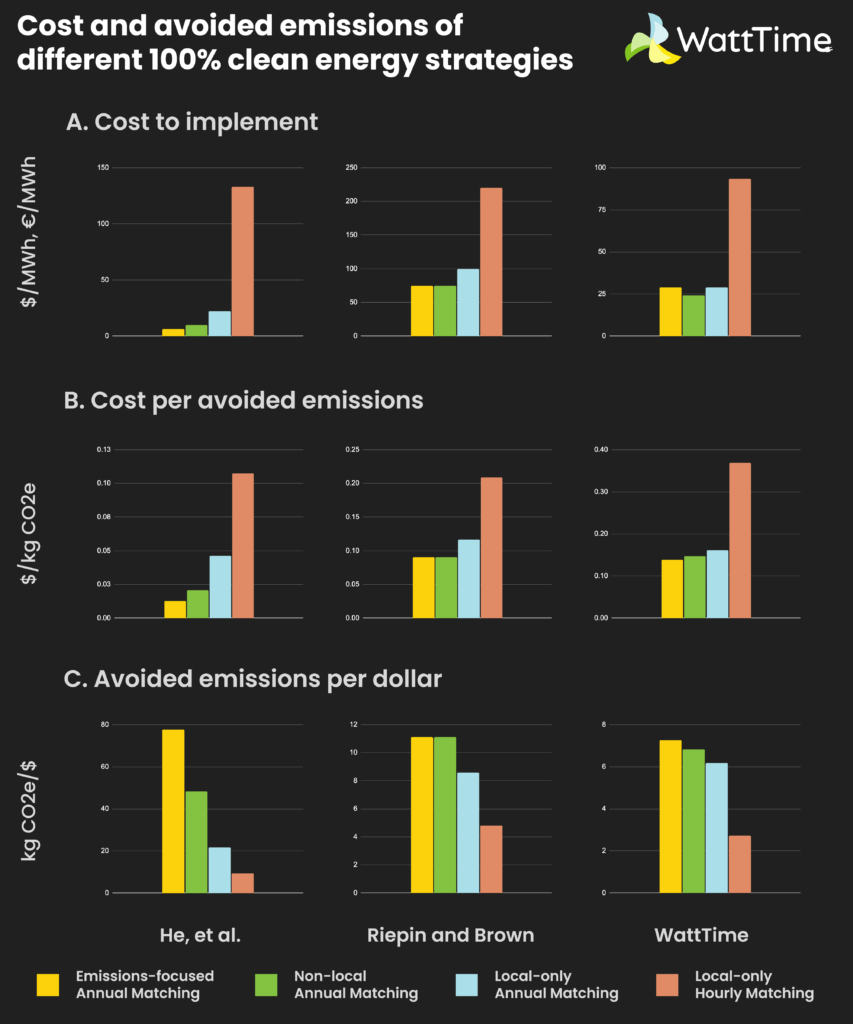
Compared to the current guideline of non-local annual matching, annual matching with a local procurement constraint was only ~60% more expensive on average (range: 20% to 120%). Emissions-focused annual matching was at cost parity with non-local annual matching (range: -40% to +20%). By sharp contrast, hourly matching was an average 600% more expensive (with a range of 200% to 1,200% across others’ studies and WattTime analysis).

Each of these studies — He, et al., Riepin and Brown, and WattTime — looked at a different set of locations and times, so cost variations are expected. However, each of these studies found a very significant cost premium for achieving 100% hourly matching, as well as large differences in the cost to achieve each kg of avoided carbon emissions. Below we show our estimates alongside others in the literature.

Understanding how cost might affect participation 

But how might these higher costs for hourly matching affect corporate participation and total emissions impact?

To answer that question, we need three things. 

First, we need to know the level of demand at the current status quo cost. How many companies currently have net-zero emissions targets under current Scope 2 rules? How much C&I electricity load do they represent? How much clean energy does that imply? 

Many studies include a scenario in which 10% of commercial and industrial load participates in net-zero claims. Our best estimate is that this is reasonably close to the actual status quo in real life (under the current system of non-local annual matching) because in 2024, total contracted energy in the US by corporations was 74.6 GW [4], which most closely matches the size of the non-local annual portfolio.

But how would companies respond to a change in cost for implementing their net-zero emissions and/or 100% clean energy strategy? This relationship between participation and price can be estimated the same way models estimate how much renewable energy grid will build: using supply and demand curves. 

So second, we need a supply curve. This curve represents how much it would cost for any given amount of companies (measured in their associated megawatts) to achieve net zero under the GHGP depending on what the rules are. We can calculate that based on the existing literature and the cost simulations above.

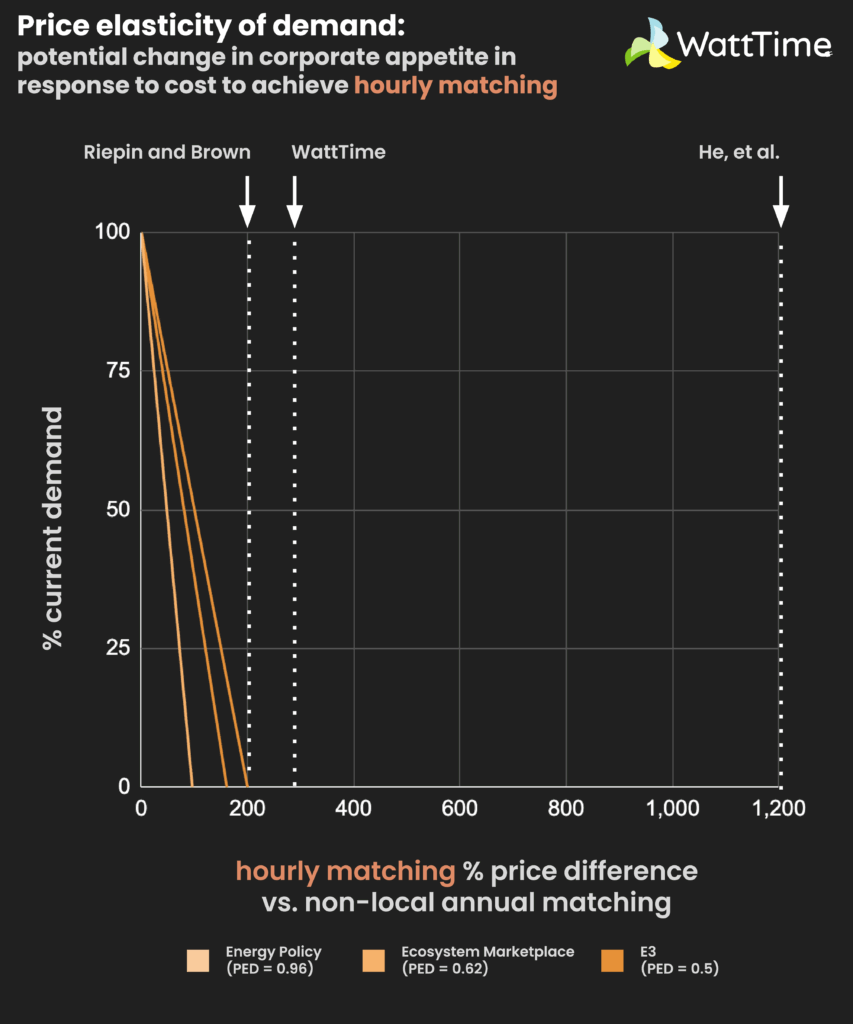
Lastly, we need a demand curve: a way to estimate what levels of participation to expect at different levels of cost. The shape of a demand curve is usually measured by its price elasticity of demand. And the price elasticity for corporate net-zero claims is not known. But, it can be instructive to ask what would happen if it is anywhere close to typical values that have been measured in similar markets, to get a sense of the scale. We found several examples in the literature: 

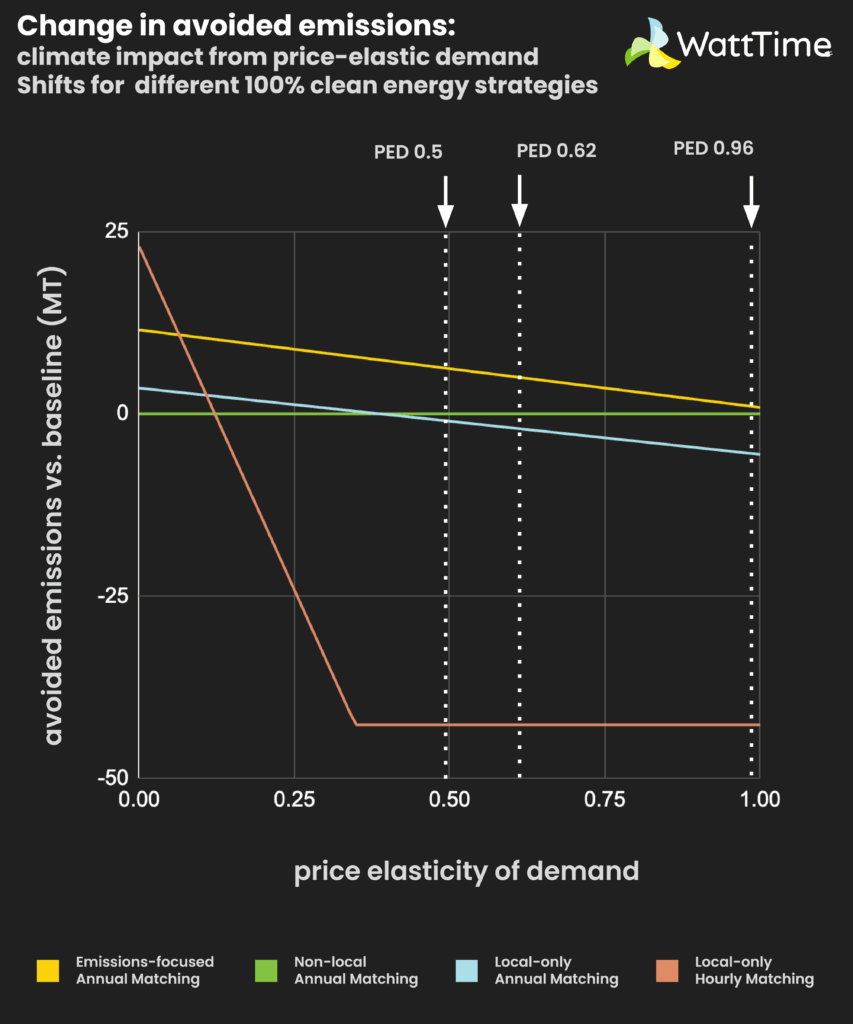
So while the actual price elasticity of demand for net zero claims under the GHGP is not known, the best estimates we have show a range including 0.96, 0.62, and 0.5.

Hourly matching’s high cost would push some corporates out of the voluntary clean energy procurement market, increasing emissions by an estimated 42.6 million tonnes annually

The big-picture takeaway is alarmingly clear. At a range of potential cost premiums to achieve hourly matching and across a range of demand elasticities, GHGP mandating hourly matching would effectively kill voluntary corporate clean energy procurement. The median estimate is that it would increase grid emissions by 42.6 MT CO2e per year, compared to existing GHGP standards of non-local annual matching.

By contrast, emissions-focused annual matching avoids more emissions than non-local annual matching at all values of demand elasticity, because while it has a slightly higher price than non-local annual matching, it also has a higher avoided emissions rate that compensates for the potential decrease in participation. 

Weighing the risk: could high costs undermine net-zero progress?

Of course, we can’t predict exactly what would happen if costs skyrocket. Supply and demand curves represent an idealized version of economics with many simplifying assumptions. Perhaps the demand elasticity of companies to make net zero claims under the GHGP is far lower than clues from previous studies suggest. Or perhaps companies might abandon their net zero claims, but still try to achieve fairly low emissions. Maybe.

But this is a big risk to take. Across several studies, the price premium for achieving 100% hourly matching has been shown to be at least 200% higher than the current standards. For that to fail to significantly reduce participation would require a massive, almost-unheard-of decrease in price elasticity. 

Further, this risk is not hypothetical. Like our analysis, E3’s 2024 study cautioned that “increases in [energy attribute certificate] EAC prices may reduce the voluntary demand for clean energy generation.” Their analysis estimated that a 4x increase in EAC prices could lead to an increase as much as 102 million tonnes per year. More recently, a survey of clean energy buyers by Green Strategies has found that “nearly 80% of respondents lack confidence that they would be able to procure time-matched clean electricity within smaller market boundaries. Respondent insights indicated concern over higher costs and whether suppliers will be able to provide resources that meet time and location criteria.”

And last week, another survey by the Clean Energy Buyers Associate found that 75% of their members are opposed to mandatory hourly matching, stating that it is “very difficult to implement”.

The rising costs of renewable energy and the changing political climate have created an environment where keeping net-zero commitments is a much more challenging goal to justify than it used to be. Raising the costs still further could make it very challenging to justify continuation of this goal to executives outside the sustainability team.

Again, this study is not conclusive. But the preponderance of evidence suggests that the massive price disparity between 100% hourly matching raises a very strong risk that the GHGP mandating hourly matching would on net cause enough price-sensitive companies to cease participating than it would on net increase emissions, not decrease them. Meanwhile, emissions-focused procurement and other carbon matching strategies would not increase costs while reducing emissions.

Future research into the effects of mandatory requirements of voluntary programs should consider effects on voluntary program participation and how that impacts total emissions. But in the meantime, the GHGP should strongly consider that what evidence does exist suggests they are currently trending toward a policy change that will increase emissions, not decrease them. 

image source: Pexels | Tom Fisk

Case study: carbon accounting approaches and an analysis of Meta’s 2023 data center electricity consumption and clean energy procurement

Executive Summary

Since 2020 Meta has matched 100% of its electricity use with more than 15 gigawatts of long-term clean energy purchase commitments, making it one of the world’s largest corporate buyers of clean energy. As a result, Meta has reduced its electricity-associated emissions reported under the current industry standard, the Greenhouse Gas Protocol’s (GHGP) market-based method, to nearly zero. But how well do these standard reported methodologies capture Meta’s physical emissions in the real world?

The GHGP has played a key role in driving over 200 gigawatts of corporate clean energy purchases. But today it is undergoing a major revision — its first in over a decade. Since it was last updated, many power grid operators and third-party providers started releasing far more granular and complete emissions data than were available at the time the current system was devised.

These new data show that the carbon intensity of electricity varies substantially by time and exact location. The emissions impact of using or generating electricity depends not just on how much is consumed, but also on when and where — and what technologies (coal, natural gas, hydropower, etc.) are on the grid at that moment. These variations in emissions impact have become even more pronounced in recent years due to the widespread deployment of clean energy. In certain times and places electricity has become very clean — for example, in West Texas when the wind is blowing — while others have changed little.

If we’re serious about reducing pollution from electricity grids and power sector decarbonization, then we need to measure the emissions impact of electricity consumption and clean energy generation more accurately, enabling companies to make informed decisions about where and when clean energy investments can have the greatest impact. The GHGP revision process currently underway provides a critical opportunity to ensure this foundational global standard better reflects real-world variations in electricity’s carbon intensity across time and place.

A key element of past GHGP updates has been examining case studies. At this pivotal moment in the GHGP’s evolution, Meta engaged WattTime to analyze its 2023 data center operations and clean energy procurement using three different methodologies currently under consideration by the GHGP. The goal was to use Meta’s real-world data as a test case for the potential implications of different approaches for all companies.

The three methodologies examined in the case study were: 1) Annual Matching (current GHGP methodology), 2) Hourly Matching (24/7 CFE methodology), and 3) Carbon Matching (emissions matching methodology). This analysis strongly suggests a need for the GHGP (and other carbon accounting frameworks) to adopt more accurate carbon accounting methodologies such as Carbon Matching that more accurately reflect real-world emissions impact and empower companies to make more targeted, better informed, and higher-impact clean energy investments. Methodologies such as carbon matching are well aligned with the three main criteria of the GHGP Scope 2 revisions: scientific rigor, will drive ambition in climate action, and feasibility.

Download the case study PDF:
How carbon accounting approaches do (or don’t) reveal real-world impacts: An analysis of three methodologies to report emissions from Meta’s 2023 data center electricity consumption and clean energy procurement.

How to use the GHG Protocol’s consequential electricity emissions reporting option

Everyone knows that there’s only one way to stop climate change: reduce actual system-wide GHG emissions. This is known as causing consequential emissions reductions. But as we laid out in our joint white paper with Electricity Maps, the GHG Protocol Corporate Standard currently mandates that companies report their attributional emissions, which are not the same thing.

At WattTime, our priority is to help companies reduce real-world consequential emissions. Whether companies then choose to report those reductions is up to them. But if you would like to do so, you may be interested to learn that the GHG Protocol today also has a separate, much less well-known mechanism to optionally report consequential emissions reductions. 

The GHG Protocol Scope 2 Guidance points out that attributional methods “may not always capture the actual emissions reduction accurately.” And adds that is a problem because “Ultimately, system-wide emission decreases are necessary over time to stay within safe climate levels. Achieving this requires clarity on what kinds of decisions individual consumers can make to reduce both their own reported emissions as well as contribute to emission reductions in the grid.”

That’s why section 6.9 of the GHGP Scope 2 Guidance states that companies interested in making decisions on the basis of actual consequential impact “can report the estimated grid emissions avoided by low-carbon energy generation and use” by using a different method, the GHG Protocol Project Protocol which is supplemented by the Guidelines for Grid-Connected Electricity Projects.

And it turns out, the Guidelines for Grid-Connected Electricity Projects is an extremely useful tool for identifying and reporting on the consequences of any activity (“project”) that causes emissions or emissions reductions. Why, then, do so few practitioners know about it? 

Partly because until relatively recently, the necessary data didn’t exist in most places. But that has recently changed significantly. 

Rising access to marginal emissions data

A few years ago, the UNFCCC began producing free, global marginal emissions data of the type you need at the country and annual level, available here

As of this month, WattTime and other mission-driven organizations have gone even further and now released free, global marginal emissions data at the hourly and balancing authority level. Those are available free at GridEmisssionsData.io (for operating margin) and https://www.gem.wiki/MBERs (for build margin). We’d like to credit REsurety, Climate TRACE, Global Energy Monitor, Transition Zero, Global Renewables Watch, Pixel Scientia Labs, Planet Labs, and Georgetown University for making this possible.

Having free, globally available, hourly marginal emissions data solves another issue with the Guidelines: they’re written as a long, complex document, particularly because they include many lists of optional choices for what to do when you don’t have good data. And now that free high-quality data exist, that extra guidance is much less relevant than it used to be. 

So, as you’ll read below, WattTime has done the work for you of going through the Guidelines with painstaking care and working out the most simple, accurate, impactful ways to comply in a world where free high-quality global data do exist. 

Key considerations in following the Guidelines

It turns out, at its core, what the document is saying is actually very simple. The key formula in the Guidelines is that the consequential emissions of any project that generates, consumes, procures, or shifts electricity is:

So, here’s what you will need to follow the Guidelines:

In many ways, following the Guidelines is very similar to following the Scope 2 Market-Based Method. For any given assessment, one combines the generation, procurement, and/or consumption by region and time period; multiplies them by the relevant emissions factors; and then adds up the times and regions to get the total emissions. The biggest difference is that the emissions factors are marginal, not average.

But there are other differences as well, such as the sign convention. The Guidelines measure (net) electricity reductions, not (net) emissions footprint. Thus, in this framework positive numbers are a good thing. But negative numbers are very much allowed — they just indicate projects that on net induce more emissions than they reduce or avoid.

Another difference is that there are several options, with no systematic decision criteria on how to choose. For example, companies are able to choose how to calculate a build margin baseline; how to select a build margin weight; whether or not to update emissions factors over time; and so on. Each of these cases opens up considerable opportunities for gaming. Further, in every case, WattTime found that sufficient free global data now exist to make using the  highest-accuracy, highest-impact option quick and easy. And although this is not explicitly stated, we’ve noticed each option appears to be listed as a de facto data hierarchy, in ascending order from lowest data requirements to highest accuracy and impact. In order to maximize accuracy and impact, and to eliminate potential for gaming, WattTime strongly recommends that, for all the lists of options in the Guidelines, companies select the final option in the list.

If you are interested in reporting on your consequential emissions impact under the optional section in the GHG Protocol, you can start using this guidance and new datasets today!

REsurety and WattTime announce release of free electricity marginal emissions data platform to drive more impactful climate action

The global power grid emissions data required to take an impact-based approach to carbon accounting and decision making are now freely available for smaller organizations, ensuring that all institutions that can benefit from the data can access it.

BOSTON and OAKLAND, Calif., March 6, 2025 /PRNewswire-PRWeb/ -- REsurety, Inc., the leading provider of software, services, and marketplace solutions empowering the future of energy, and WattTime, an environmental tech nonprofit working to multiply positive climate impact, have today announced the launch of the Grid Emissions Data platform — a free and open resource which provides high-quality marginal emissions data covering the entire globe to qualified end users worldwide to enable an impact-based approach to carbon accounting and decision making.

Marginal emissions data, which measure the carbon impact of consuming or generating electricity at a given time and location, are a critical tool for maximizing and accurately measuring real-world carbon impacts. For example, marginal emissions data enable a strategic approach to clean energy procurement like the one McKinsey & Company recently found to be most effective at reducing emissions. But high-quality data of this nature can sometimes be difficult to access for companies without the budget to pay for it.

"...using data like these to optimize electricity procurement, load shifting, and siting decisions at scale is the only climate solution we've seen with the potential to rapidly reduce over 8 billion tons of carbon dioxide equivalent per year." —Gavin McCormick, WattTimePost this

The Grid Emissions Data platform was made to serve small corporate buyers of clean energy and industry researchers with freely accessible, high-quality, accurate, and granular marginal emission data via a single, third-party website and database.

"More and more organizations are committed to accurately reporting the real-world impacts of their clean energy procurements," said Lee Taylor, CEO of REsurety. "The Grid Emissions Data platform will support and accelerate that trend by offering the highest quality data available, free from the constraints of a paywall."

The marginal emissions data provided on the new platform are consistent with the operating margin data guidelines established in the Guidelines for Quantifying GHG Reductions from Grid-Connected Electricity Projects — part of the The GHG Protocol for Project Accounting published by World Resources Institute (WRI) and The World Business Council for Sustainable Development (WBCSD). In addition, the platform directly supports the kind of approach espoused by the Emissions First Partnership; the group of corporate and tech leaders has called for a shift in corporate carbon accounting standards away from megawatt-hour matching and toward an emissions impact-centric system that maximizes greenhouse gas reductions.

"Slashing emissions is more urgent than ever. And using data like these to optimize electricity procurement, load shifting, and siting decisions at scale is the only climate solution we've seen with the potential to rapidly reduce over 8 billion tons of carbon dioxide equivalent per year," said Gavin McCormick, founder and executive director of WattTime. "That's why we knew — as two mission-driven organizations — that giving away these free data was just the right thing to do."

Designed, developed, and maintained jointly by WattTime and REsurety, the Grid Emissions Data platform offers hourly marginal emissions data on a global scale from the prior three complete years in CSV download format. Users can retrieve data by node, region, or sub-region, where available, and data will be updated at least annually.

Qualified end users — including most smaller buyers of clean energy, auditors, academics, and regulators — can download their selected data at GridEmissionsData.io after completing a simple, free data-use agreement.

For additional questions, email contact@gridemissionsdata.io.

About REsurety
REsurety is the leading provider of data, software, and services to the clean energy economy, and operates the only transactional marketplace for clean power. Trusted by the industry's leading buyers, sellers, and investors, REsurety's proprietary data models, powerful technology platforms, and deep domain expertise empower confident, impactful decision-making and efficient, effective portfolio management. For more information, visit www.resurety.com or follow REsurety on LinkedIn.

About WattTime
WattTime is an environmental tech nonprofit that empowers all people, companies, policymakers, and countries to slash emissions and choose cleaner energy. Founded by UC Berkeley researchers, we develop data-driven tools and policies that increase environmental and social good. During the energy transition from a fossil-fueled past to a zero-carbon future, WattTime 'bends the curve' of emissions reductions to realize deeper, faster benefits for people and planet. Learn more at www.WattTime.org.

Media Contact
Nikki Arnone, Inflection Point Agency for REsurety and WattTime, 1 (719) 357-8344, nikki@inflectionpointagency.com, gridemissionsdata.io

SOURCE REsurety and WattTime