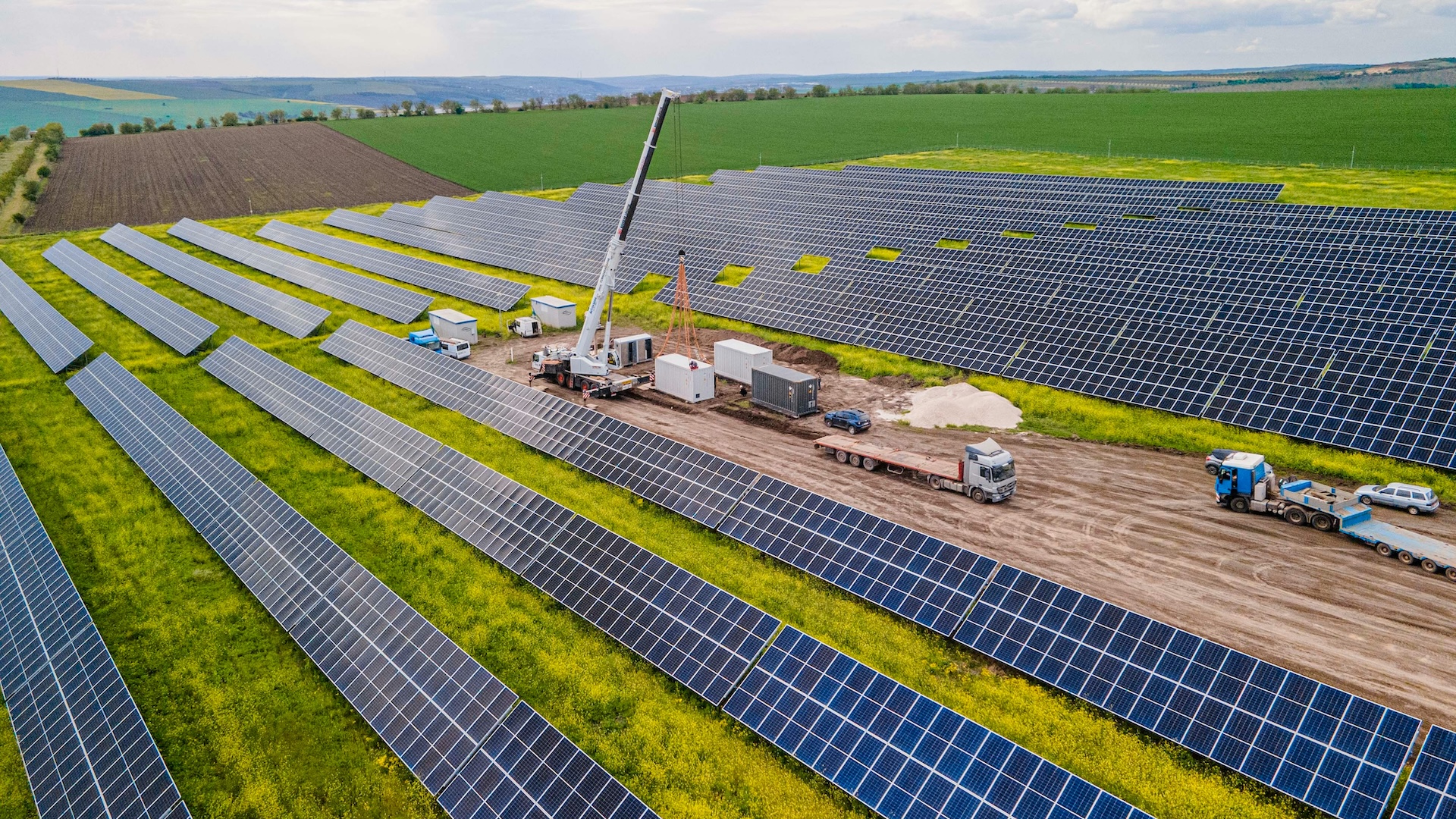

Making RECs Matter Again: how Ever.green bakes additionality and climate impact into every MWh
September 1, 2026
by Daisy Simmons
Despite the prevailing view that RECs writ large have fallen out of favor among corporate clean energy buyers, the latest numbers tell a different story.
According to I-REC's market statistics, 2025 saw record levels of both issuances and redemptions. The Intercontinental Exchange — which accounts for as much as 90% market share in REC futures trading in PJM — saw record levels of environmental futures and options trading in 2025 compared with prior years.
And so far the momentum is continuing in 2026, with REC futures and options up 31% in June 2026 versus one year earlier, per Nodal Exchange.
Measurable climate impact, made accessible
WattTime partner Ever.green is a stellar example of RECs worthy of the momentum, with its portfolio of clean energy projects specifically selected to “make dirty grids cleaner.”
The company’s focus on RECs versus other renewable energy procurement strategies is no accident. Buying renewable energy is one of the most common ways companies use their dollars to reduce their climate impact, says Ever.green chief revenue officer Liz Pearce — but not all approaches are created equal, or equally within reach.
VPPAs bought up by big buyers and hyperscalers have been "transformational" in bringing new capacity to the grid, she notes, yet that approach has largely stayed out of reach for most companies. RECs, by contrast, are everywhere.
“Hundreds of thousands of companies buy standard green RECs every year,” Pearce says, “but it’s much more difficult to connect those purchases to the addition of new clean energy capacity.”
Ever.green was built to close that gap. Rather than a standard REC, where the link between dollars and new capacity is murky at best, the company’s credits are centered around both additionality, proof that the purchase itself helped bring new clean power online, and emissionality, allowing purchasers to see and make decisions based on the estimated avoided emissions of the added clean power.
The journey to High-Impact RECs
This confidence didn't come from a simple pivot. Founded in 2021, Ever.green launched with a different idea altogether: to break down traditional VPPAs into smaller pieces so smaller buyers could join in. The contracts proved too complex and lengthy, though, and required credit ratings most buyers couldn’t meet. That level of aggregation never developed into a meaningful slice of the market — large corporates individually signing big direct and virtual PPAs has remained the norm. Recognizing this, the focus shifted to opening up the market with a more direct path to enabling smaller companies to contribute to the development of new and impactful clean energy.
That journey led to a major milestone in 2024, when Ever.green solidified its methodology and published a white paper to make its screening process fully transparent. While the rest of the industry was still debating the best way to test for additionality, Pearce’s colleagues decided to build a practical system to measure it.
Today, the company’s process focuses entirely on giving projects the final push they need to get financed and built. To qualify, a developer must contractually attest that the REC contract improves a key financial metric — like internal rate of return, revenue, or levelized cost of energy — by 10% or more, a guarantee passed straight through to the buyers.
"The spirit of what we're trying to do here is to find those projects that are right on the edge, and give them that final push to get built,” says Pearce. “If the REC contract makes a material financial difference to bringing the project online, it drives real impact. And that is what our buyers are responding to.”
Using long-term forward contracts of at least 5–10 year terms is another way Ever.green ensures RECs will be material to the financial viability of new projects. Longer terms provide a more predictable revenue stream that can influence project financing decisions.
A recent study backs up the potential impact, too, finding that some standalone RECs generate revenue that can reduce the financial distress from a project’s wholesale market exposure, indicating they contribute to project viability.
Harnessing marginal emissions data to measure impact
A core pillar of Ever.green’s methodology is ensuring that every megawatt-hour of clean energy delivers the greatest emissions reductions possible. To do this, the company leverages WattTime data to inform three distinct views of likely impact:
- A backdrop of America’s power grids: Ever.green’s High-Impact REC map allows buyers and sellers to quickly toggle between four different views of US grid regions: average emissions factor, marginal emissions rate, benefit of new solar, and benefit of new wind.
- A data-driven forecast: Project listings include estimated future avoided emissions.
- An ongoing proof point: The platform tracks estimated historical avoided emissions for each REC once the project is live.
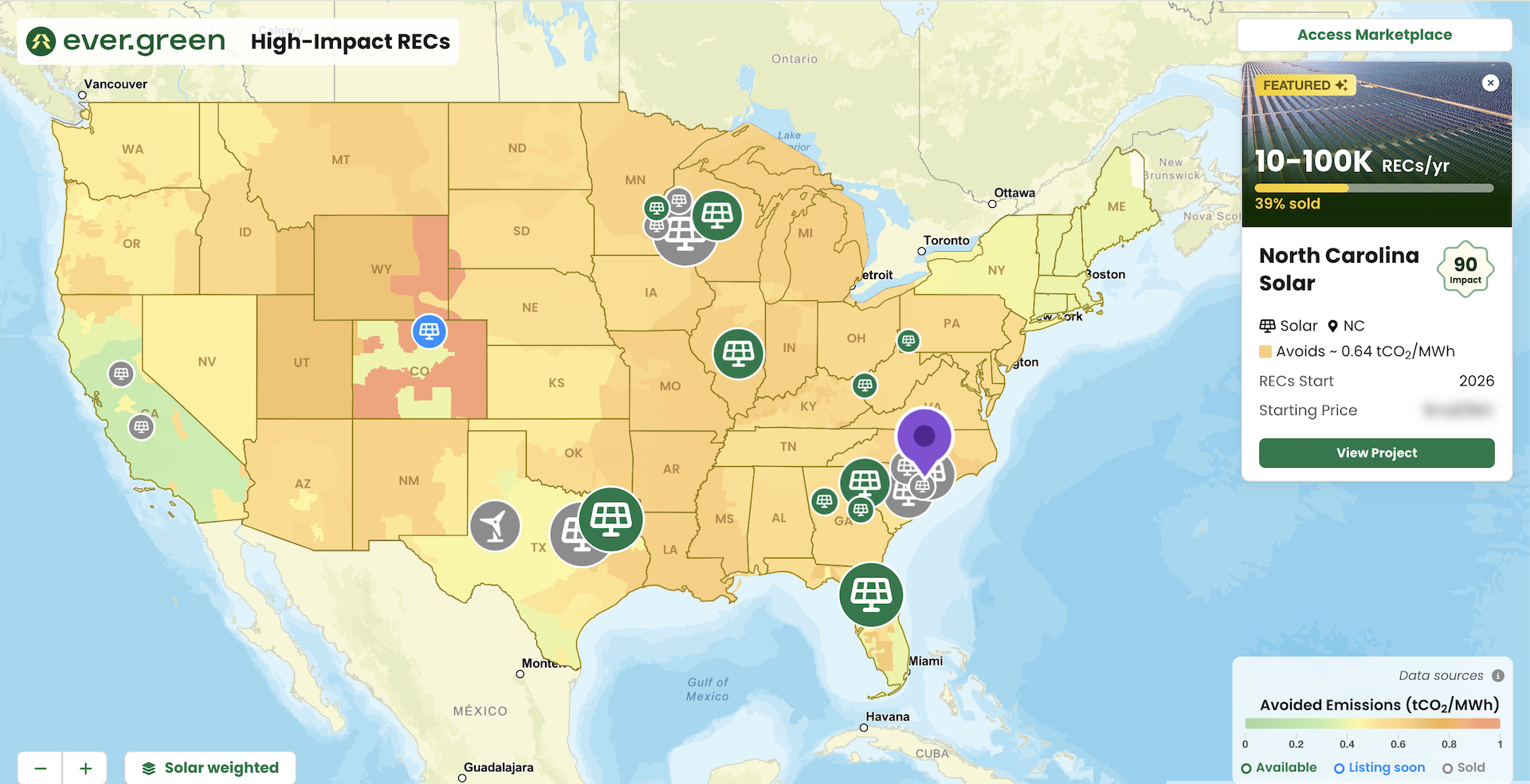
Ever.green’s interactive map gives buyers granular, project-level transparency before they invest. For example, here, a solar project listing in North Carolina shows an avoided emissions profile of 0.64 TCO2/MWh, alongside other metrics.
"We’re always trying to help buyers get more emissions bang for buck, and that’s why we look to support projects in dirtier grids," says Pearce. "The data in our marketplace helps buyers evaluate opportunities, whether they want to maximize emissions reductions or support a project in a location that has deep meaning to their company."
To turn this data into a contractually binding asset, Ever.green works its standardized scorecards directly into agreements. These allow developers to share more about a project’s holistic impact — covering additionality, emissions, land use, wildlife, labor standards, materials, and community benefits.
"If you read sustainability reports and a company claims 100% renewable energy with no details, there’s a high likelihood they’re buying standard spot-market RECs," Pearce explains. "Our buyers are different. They want to point to a specific project, timeframe, and long-term impact."
Ever.green’s current contract structure (commitments to purchase a fixed volume of RECs at a fixed price from a yet-built project) has helped them solve the aggregation puzzle that eluded them early on. They can now break large projects down across dozens of buyers, acting as a single counterparty for the developer while opening doors for smaller companies. A recent project, for example, was split among 15 different buyers. This model has proven to work for what Pearce calls a diverse "cornucopia" of types of projects, ranging from massive grid infrastructure to community solar to rooftop systems on public schools.
The next horizon: Scope 3 and global impact
Public awareness is catching up to the work Ever.green has been doing, with more organizations realizing that traditional clean energy buying needs to evolve. To carry that momentum forward, Pearce says the team is preparing for the next great frontier: Scope 3 supply chain emissions.
New international markets are also a part of that push. Ever.green is expanding support for buyers outside the US, many of whom are looking to decarbonize their own supply chains. Interest picked up considerably over the past year, Pearce says, and while Scope 3 is hard for most companies to solve, Ever.green has found a way in.
That work has put the business in touch with companies that have never had to think about clean energy before.
"Some of these smaller companies have never even done a carbon inventory before. And for the people we’re talking to, it’s not their core job — we've literally worked with payroll analysts who were suddenly assigned the task of buying renewable energy," Pearce says. "It is incredibly fun to build their understanding and give them an accessible solution they can easily transact on."
The goal, ultimately, is to turn that ease of access into something bigger: a shift from passive box-checking to active grid transformation.
"We always say that doing anything is better than doing nothing, but if you can do more, you should make the case to do more," Pearce says. "There are pathways that don't take up your entire sustainability budget but give you something incredibly relatable and tangible to show your stakeholders. It shows them whether your strategy is all talk or meaningful action. You can do it without a lot of complexity — and I am highly optimistic more companies are going to go this route."
To learn more about High-Impact RECs — and the marginal emissions data behind them — visit Ever.green.